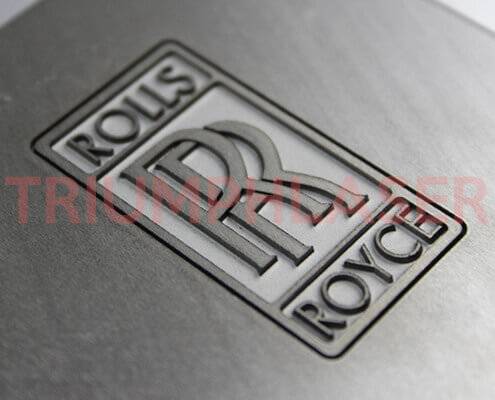
LASER MARKING METAL

Laser marking metal is an extremely precise and clean way to process metals with non-contact, permanent markings. Labels such as serial numbers, data matrix codes and logos can be applied to products and components with a high-resolution finish. Metal marking or engraving is created by the laser using a non-contact process that requires no pre- or post-processing. Markings produced by annealing serve as durable, acid, chemical and corrosion resistant labels that do not damage the metal surface.

WHY LASER MARKING METAL

The Advantages of Fiber Laser Marking Metal

It does not affect the integrity of the part;
Produce a high-contrast permanent mark;
Requires almost no maintenance;
Can be operated from almost any Windows-based software;
Is exceptionally easy to use by practically anyone in your organization!

APPLICATION EXAMPLES MADE OF METAL

  • Product labeling as an anti-counterfeiting measure,
  • Functional labels such as size, diameter, etc.
  • Production information, such as date of manufacture, batch number, serial number, etc.
  • Traceability codes
  • Data Matrix codes for quality assurance
  • Customization of promotional and gift items made of metals,
  • Dataplates

Laser application in marking metals are typicaly used for marking products with traceability features and codes. These applications can be found in the electronics and electrical industry, mechanical engineering and tool manufacturing, in sheet metal processing, medical technology, promotional materials, jewelry and in the automotive industry.

Suitable types of metal for laser marking

  • Stainless steel
  • hardened metals
  • alloy steels
  • high-speed steels
  • aluminum
  • anodized aluminum
  • titanium, titanium alloys
  • hard metals
  • brass
  • copper
  • precious metals
  • coated metals

METHODS OF LASER MARKING METAL

Polishing:Polishing leaves a white mark on stainless steel and other metals. It can be seen as a “lighter” way of engraving. The energy of the laser is reduced, which means that less material will be vaporized. The result is less ablation on a material like steel and a brighter marking. Regarding the parameters this means less power and higher speeds that result in less energy per distance and higher frequencies that result in less pulse energy. Polishing is not only possible on steel but on all metals.

Engraving:Engraving leaves a tangible mark on stainless steel and other metals. It leads to an ablation of the material on steel parts. The material vaporizes and the color changes. Due to the very high energy of the laser, materials like steel, titanium and other metals can be vaporized directly.To achieve ablation, high powers and relatively slow and medium marking speeds are required. The lower the frequency, the higher the possible pulse energy. That means the lowest possible frequency should be chosen for engraving. The brown color that is left by the burned metal can be cleaned (see Polishing).

Annealing:Annealing leaves no tangible mark on stainless steel and other metals. During the annealing process no material is taken away, which means there is no ablation. Instead a color change occurs through heating up the metal. Stainless steel, for example, changes color when it reaches temperatures between 200 and 300°C. Different colors can be achieved with different temperatures.To anneal metal, it is important to only heat it instead of vaporizing it. This can be achieved by reducing the energy density of the laser impact on the steel. The best way to do so is to go out of focus to increase the laser spot size.

Function of laser technology

  • Direct marking does not increase costs for consumables such as inks, chemicals, pastes or sprays.
  • The need for handling and disposing pricey materials is eliminated.
  • No pre- or post-treatments are required
  • Tool wear is eliminated
  • High speed marking with variable data is possible e.g. serial numbers, codes
  • A wide range of markings are possible without retooling or tool changes
  • Unlike other technologies, laser marking is permanent and abrasion, heat and acid resistant
  • Especially important for traceability and quality assurance
  • Precise and small shapes can be marked with extreme accuracy
  • Marking processes can be combined to clean the material after processing or to provide a higher contrast (e.g. Data Matrix codes)
  • Virtually any design can be created with the laser.
  • It is even possible to create 1-point fonts and tiny shapes that are still clearly legible.
  • Complete freedom in the design of markings, logos, designs, bar codes or serial numbers
  • Even photos can be produced in the shortest possible time.
  • There is no need to firmly clamp down or fixate materials
  • Time savings and consistently good results